First Trip to the Isle of Skye | Scotland
It’s certainly been a few years since I explored another of Scotland‘s islands, or indeed, took any weekend trips around my own country! Having previously ventured to Arran, Islay and Mull, the obvious next island of the Inner Hebrides on my list was Skye. It’s the most popular of Scotland’s islands with visitors, and yet I’d never been before, so last September, I finally took my first trip to the Isle of Skye! I tacked it on to a visit to my new work’s office in the Highlands, to reduce the distance to travel. While Skye does have bus services, I knew driving was going to give me far more flexibility. As well as good practice – I’ve never been a fan of driving! – since this was a solo trip.
So, I picked up a hire car in Inverness and then drove to Kyle of Lochalsh, where I stayed for three nights. I couldn’t get any affordable accommodation on the island itself, so I drove across the Skye Bridge, which connects it to the mainland each day. It was a 3-day, long weekend trip, with Friday and Saturday spent on the island. Then on Sunday, I drove back to Inverness, making a few other iconic sightseeing stops along the way.

Day One
I woke up at the crack of dawn on Friday morning, crossing the bridge to officially start my first trip to Skye. Today had the best weather forecast of the weekend, so I was off to the Trotternish peninsula, to the north of Portree, which has some of the island’s most famous geological features. They’re also some of the most accessible, with car parks off the main road next to them all. The car parks fill up fast, though, hence my early start, which paid off when I was able to pull in straight away to the Old Man of Storr.
Old Man of Storr
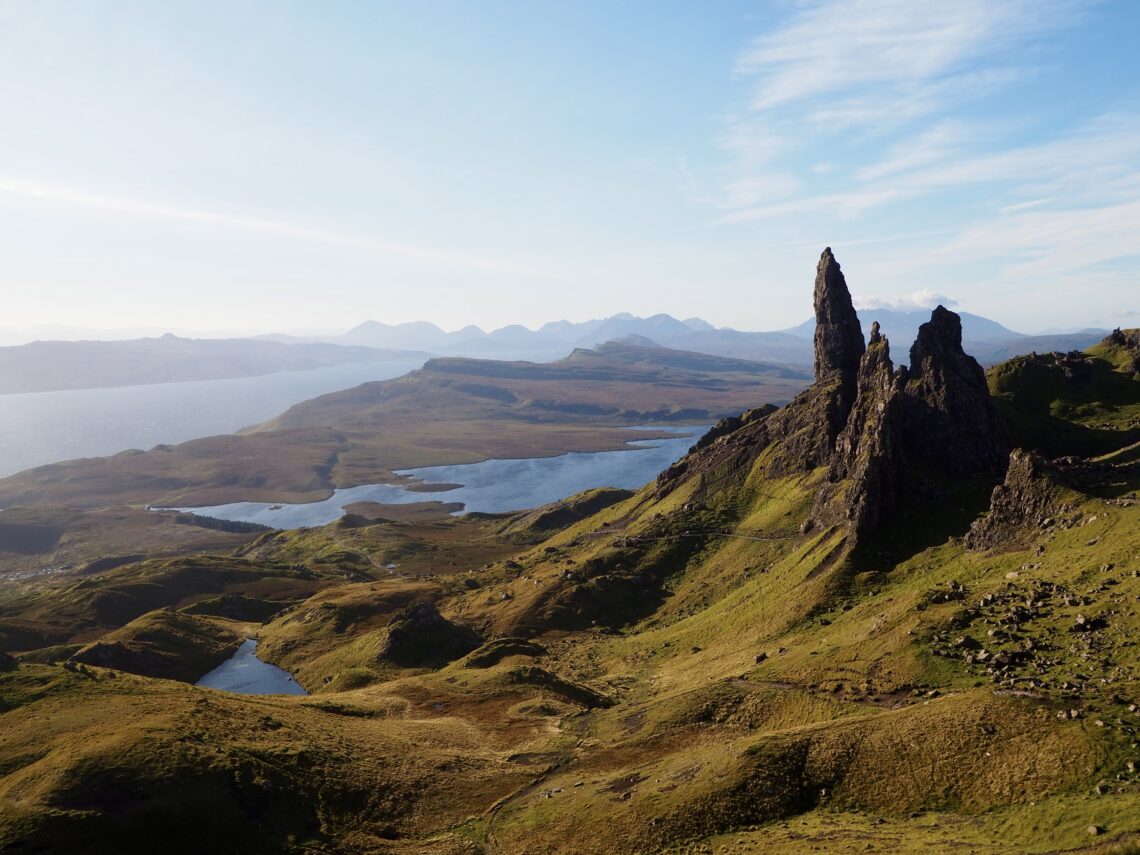
The Old Man is a tall, spiky tower of basalt rock, which sits beneath the tabular mountains of the Trotternish Ridge that spans the peninsula. To get the best viewpoint, you have to hike up from the car park, passing by the Old Man, to reach a viewpoint beyond it. The hike takes maybe an hour and a half round trip, on a clearly marked path. Sections of it are large, rocky stairs, and pretty much the whole thing is uphill. The toughest part for me was the final climb to the viewpoint, not for the ascent itself but for the brutally strong wind hitting this particular section! I had to climb back down practically sitting and sliding, because I could barely stand upright.
The view was worth it, though, the sun glancing off the spiralling column of rock, and the deep blue of Loch Leathan visible in the distance. I enjoyed the views along the way as well, traversing the path as it weaves through these massive rock monoliths scattered across the steep mountain slopes. The whole place felt so ancient and majestic.
Mealt Falls
Continuing to follow the road that loops around the peninsula, I first made a stop at Lealt Falls. This is less popular than its cousin, Mealt Falls, perhaps because it’s harder to see! I followed the path that cuts down the steep cliff face of the island, dropping into the sea below. The waterfall is situated up an inlet cut into the shoreline, and even at the end of the path, I could barely glimpse it. And my fear of heights – or, I suppose, fear of falling off cliffs – wouldn’t let me go beyond the path as some other people did.
Anyways, Mealt Falls is a lot easier to see, as the car park is right next to it. You just have to walk to the fenced viewing area atop the cliff, and it’s right next to you. The river courses across the island before reaching the shoreline and dropping off the edge straight into the ocean below. It’s such a unique type of waterfall, plunging straight into the sea this way. Along the coast behind it, you can also see Kilt Rock from the same viewpoint, named because the rocky cliff face resembles the pleated folds of a kilt. I was more interested in the waterfall, to be honest, but it’s cool to see two natural formations at once, of course.


The Quiraing
Driving onwards again, I passed through some small villages before leaving the main road to turn onto Quiraing Road, a narrower, often single-track road that cuts across the peninsula and leads to the Quiraing itself. This is a popular hiking spot, with the main Quiraing loop taking 2-3 hours to complete. I hadn’t been sure if this was one I wanted to tackle solo anyway, but the decision was made for me when I was packing and realised my hiking boots were at my parents’ house. Maybe I’ll return one day with someone else to try it! But I still wanted to come up here and see the scenery, and there are some short walks instead. It took a little longer to find parking here, as it was now late morning!
The Quiraing is a particularly dramatic area of the Trotternish ridge, a high rampart of rock overlooking a deep crater-like hollow, with other plateaus and pinnacles of rock scattered within. I walked into the crater until the path got too tricky to handle without proper boots. The full loop takes you through the hollow and then up and over the top of the rampart. But it was still far enough to see the vast, sweeping landscape. Which becomes all the more impressive when you turn slightly in the other direction and remember how high this area is, the Trotternish Ridge stretching south into the horizon, and overlooking the massive flat valley below, which meets the sea to the east. For an island, Skye is pretty huge!
Fairy Glen
The Quiraing road brought me to the opposite coast, on the west of the peninsula, and the village of Uig, where the ferry to the Outer Hebrides departs. After a quick bathroom stop here, I headed up a narrow track off the main road and parked at the Fairy Glen. This is an easy walk, taking under an hour to loop through the landscape. The scenery here is smaller than what I’d seen so far this morning; it makes sense when it belongs to the fairies!
But it’s no less wondrous as you wander through this glen of small, rounded hillocks, with lochans scattered between them. Its highest point is a column of basalt rock atop one of the hills. Meanwhile, more rocks lie in the glens between the hills, these ones arranged into concentric circular patterns. The fairies at work! It’s a delicate and peculiar sort of landscape, quite the contrast to the big, sweeping vistas I’d seen so far. It wasn’t quiet, as such, but it did feel less busy than the other locations, lending an air of secrecy and mystery to the atmosphere as well.


Re-routing!
After the Glen, my original plan was to complete the Trotternish Loop by driving back to Portree for a look around before returning to Kyle of Lochalsh for the night. Then tomorrow I would head west to the Fairy Pools. But I was painfully aware that tomorrow’s weather forecast was to be pouring wet, and it was still so sunny today and only early afternoon. It would mean extra driving and retracing myself tomorrow, but I knew the Fairy Pools would look gorgeous in the sunshine. Scotland’s weather is unpredictable, so sometimes it’s worth re-routing your plans to accommodate it!
After an internal debate with myself, I went for it, bypassing Portree and arriving at the Fairy Pools by late afternoon. The drive isn’t the easiest, following a narrow road that’s frequently single-track with passing places, and littered with pot holes. As someone who doesn’t like driving at the best of times, this was a test of concentration! But luckily again, I got parked pretty easily on arrival with plenty of spaces in the large car park.
Fairy Pools
Skye might be known as the ‘Misty Isle’, but today it certainly was not! And while the mist can make for some pretty atmospheric photos, as a Scot used to overcast weather, I was very glad to see the sun. The Fairy Pools are part of the River Brittle, or Allt Coir’ a’ Mhadaidh to use its Gaelic name. A series of small waterfalls and pools is scattered up the length of the river, with a walking trail running alongside it. The water is dazzling blue and turquoise, sparkling bright in the sun, reinforcing my decision to drive here today!
If you’ve seen photos before, the angles can be deceptive: the falls were smaller than I expected, whereas the mountains of Cuillin Hills behind it, where the river starts, are huge. Like the Fairy Glen, though, it makes sense that a landscape named for the wee folk would be smaller and daintier. The walk is mostly flat, though the fierce wind was back, making it tougher going than it would have been otherwise. It’s also nice from an accessibility standpoint in that there are so many falls and pools along the river, you don’t need to walk that far to see some of them.
I chose to do a longer walk, spending about an hour and a half round trip from the car park here. The path got quieter the further I went, and I do think some of the most scenic pools were further up! I also just wanted to soak in this pretty scenery in the sunshine for as long as possible.


Sligachan Old Bridge
Returning from the Fairy Pools, I had to pass through Sligachan, where I’d turned off for them in the first place and which I’d passed through this morning as well. The high mountains of the Cuillin range mean you have to time it right for the light, though, to not be fully in shadow as it was this morning! The main reason to stop here is the Old Bridge, a gentle stone arch over the bubbling river beneath. The mountains make for a stunning backdrop, providing breathtaking scenery without a hike involved! The old bridge is for pedestrians only, while a newer one carries the road instead.
Many people walk down to the river here to try the old folk belief of sticking your face in the water for eternal beauty. I opted to skip this – it looked freezing! Instead, I wandered up the opposite bank to see the statue of Collie, a renowned climber, and Mackenzie, a local crofter, who were pioneering mountaineers of the Cuillins. I liked how it was positioned, with them facing towards the mountains where they spent so much time. With the late afternoon light casting the land in shades of gold, it was a very serene spot to finish the day, before I returned to the mainland once more.


Day Two
The next morning was decidedly wetter and more overcast. Exactly why I’d chosen to fit in extra sights yesterday! With that in mind, I had a much later start this morning since I had less distance and sights to cover this time. Plus, I’m not the most confident driver in the rain, so I wanted to take it carefully. Crossing the Skye Bridge again, I set off towards the west of the island for some indoor activities.
Talisker Distillery
Talisker whisky is up there amongst my favourites, so I wanted to pop into the distillery. I hadn’t booked to do a tour, as I find the distilling process is pretty much the same everywhere. And a tasting was off the cards when I had to drive. But I wandered into their visitor centre and shop for a look around, and ended up buying a tasting pack of three different whiskies to take home. The distillery itself is in Carbost, sitting on the shores of Loch Harport, a sea loch stretching inland. This gives the whole place a salty maritime atmosphere, which is reflected in the distillery’s design as well.
On my way out, I stopped into the Caora Dhubh (‘black sheep’) coffee shop across the road. Sipping my drink under the cover of their tiny deck overlooking the loch, I was truly experiencing the ‘Misty Isle’, with everything cast in a dewy haze even when the rain wasn’t falling.


Dunvegan Castle
Winding my way up the island’s western shores, my next destination was Dunvegan Castle, an ideal indoor option for a wet day. The Castle is the ancestral home of Clan MacLeod, and it feels more like a stately home once you get inside. Rooms full of antique furniture and large portrait paintings, as well as the kitchens and servants’ quarters downstairs. The most interesting item, in my opinion, is the Fairy Flag, a silk banner encased in a glass frame to preserve it now. Historians date it as from the 4th century, crafted in the Middle East. But according to the MacLeods, it was given to the family by a fairy, and worked as a powerful talisman to bring them victory when it was unfurled in battle. Skye is certainly full of the mystical and magical!
The Castle also has lush gardens, and I managed to take a quick wander through them during a break in the rain. Naturally, everything was damp and humid, but the twisting paths through dense forest were fun to explore. You can wander down to the shore too, walking out onto the small promontory to look back at the Castle as it sits by the waterfront.
Portree
To finish up my day, I pivoted back to my altered plans from yesterday and drove east (on a very empty road!) to Portree. This is Skye’s largest town, with the most shops and services, and the most popular base for tourists. Parking near the town centre, I first headed down to the harbour, where you can find the iconic colourful houses along the shorefront. These aren’t unique to Skye of course – I’d argue Tobermory on Mull is more famous for the coloured houses – but they’re still pretty to go take a look at!
Climbing the hill back into the town centre, I whiled away an hour or two browsing the many shops. Skye is home to lots of local artists, so there was jewellery, paintings, textiles and even sheepskins to discover. I also spent a fair amount of time in a bookshop, and checked out a couple of the souvenir/gift places. I wasn’t here to buy much, but it was nice to have a look, and another good option for a rainy day. On my way out of town, I also made a stop at the Isle of Skye Candle Company. I’m familiar with them already, as they have an Edinburgh shop too, but I still bought a couple of small candles to bring home. From there, I headed back to Kyle of Lochalsh, ready to turn in after two busy days on the island!


Day Three
The final day of my first trip to Skye was not spent on the island at all. Instead, I started winding my way back towards Inverness. After doing the outbound drive in one go on Thursday evening, and half in the dark, today I was taking my time and making stops along the way. The sun was back out today, so I started this morning with a quick walk down to the waterfront in Kyle of Lochalsh, to get one last glimpse of Skye from across the water, and finally take some pictures of the Skye Bridge I’d driven over so many times now!
Eilean Donan Castle
Returning east, following the shores of Loch Alsh, my first stop was only about half an hour away, Eilean Donan Castle. This might be one of the most photographed and picturesque castles in Scotland, situated on a tiny island where three lochs meet. An arched, stone footbridge connects it to the mainland. Getting here in the morning was ideal, as the sun was shining from the east directly onto the Castle as I approached from the car park. It’s so pretty and romantic, and I got the perfect reflection on the water of the loch as well.
It’s free to view from the mainland, but crossing the bridge requires a ticket – you can visit the grounds only, or the interior as well. I got the full ticket, and it wasn’t as busy inside as I expected, perhaps because a lot of people just take photos from outside! Photos aren’t allowed inside the rooms, but there were several to explore, full of furniture, portrait paintings and heraldry. There was a kitchen recreation downstairs too, and a fair amount about the family’s military history. The Castle was the seat of Clan MacKenzie and later Clan MacRae, the latter of whom are still the Castle’s constables (though it’s owned by a Trust).
Outside the main Castle, you can walk a loop around its walls, enjoying the loch views from all angles. The sun was dazzling, and I was delighted to see the cormorants drying their wings in the bright morning light. I read about the various garden plants on the way around, before completing the loop – it’s not that big of a Castle really! – and retracing my steps back across the stone bridge. A quick coffee stop at the cafe, then it was back on the road east again.


Urquhart Castle
Another loch, another castle. My drive was taking me up the western shores of Loch Ness, Scotland’s most famous loch. From fairies to lake monsters, I really was covering all the mythology this weekend. As well as the creature in its depths, Loch Ness is also Scotland’s largest loch by volume (Loch Lomond has it beat on surface area and Loch Morar on depth). It holds more freshwater than all of England’s rivers and lakes combined, which is staggering, really! It’s so long and skinny that you only see a bit of it at a time. I’ve been to Fort Augustus, at the southern end, and done a cruise before. But this was my first visit to Urquhart Castle, located about halfway up the western shore. This is another iconic and frequently photographed Scottish castle.
Starting in the visitor centre, I went into the media room to watch the introductory video with an overview of the castle’s history. At the end, the screen opens up to reveal large windows with a gorgeous first look at the castle. From there, I headed outside and down the path, passing the very impressive catapult along the way! Urquhart is largely in ruins now, blown up for the last time during the Jacobite uprisings, after centuries of conflict before that as well. You can still climb up into various parts of it, including Grant Tower, and there are lots of signs explaining what everything used to be. The history was interesting, and the weather made for beautiful loch views all around. It was busy, of course – I was glad I pre-booked my ticket with parking! – but I’m glad to have finally visited such a well-known castle.


Inverness
After dropping off my hire car, I spent a final night in Inverness. I arrived mid-afternoon to allow some time to explore the city, which I’d never been to before. It’s not a huge city, with the usual high street shops in the centre. I was staying by the banks of the River Ness, so I took a walk along its shore. I crossed the river via the Ness Islands, a couple of small islands used as a public park, connected by footbridges. It was late in the day, so not very sunny to enjoy them, but it was still nice to see nature in the middle of the city. I also saw the outside of Inverness Castle and the Cathedral as I returned up the opposite shore, though both were closed for entry.
My hotel was Glen Mhor, which has the Uile-bheist Distillery and Brewery on-site, so guests get reduced prices for the tours, which run into the early evening. It’s a newer distillery, and you don’t find many in city centres like this. The tour was super interesting, as the owners had it built with sustainability and a low-carbon footprint in mind. The artwork is also really cool: ‘uile bheist’ means ‘water monster’ in Gaelic, and the distillery is adorned with murals of creatures from Scottish folklore. And of course, the tour finished with a tasting of a beer, a whisky and a new-make spirit in the taproom. A great way to finish up my weekend!


First Trip to the Isle of Skye
It would be remiss of me not to mention how busy the Isle of Skye is. As someone who works in Scottish tourism, I know it’s by far the most visited of our islands by tourists. Which results in packed car parks, camper vans overnighting in every layby and a shortage of affordable accommodation for residents. Of course, tourism can bring benefits, and it certainly creates lots of jobs on Skye! But there needs to be balance, and I would encourage visitors to Scotland to explore other parts of our country, both islands and on the mainland. I didn’t even object to paying an awful lot of money for parking all weekend, as that money goes back into supporting local community projects!
Anyway, I’m glad I finally took my first trip to Skye, as it really is stunning. Obviously, the weather on the first day worked to my advantage, getting photos of those iconic landscapes looking their best. It wasn’t even as busy as I’d been bracing myself for, the benefit of going near the end of the season. Towering mountains, dramatic waterfalls and the delicateness of fairy pools and glens, it really is beautiful. Of course, I didn’t get around to everything on my first trip to Skye! I’d love to go back and do the actual distillery tour and tasting; visit Neist Point Lighthouse; take a wildlife-spotting boat trip; and explore Loch Coruisk and Elgol. There’s definitely more still to see!
Visiting the castles and Inverness on my way back on the last day was great as well. I could have returned to the Isle that morning, of course, but it was nice to take my time driving back and break up the journey. And see a couple more of Scotland’s most famous sights along the way!